
Got a question about something? Lets have a chat.
WORKPLACE MENOPAUSE & THE LAW
By Jo Ibbott
June 2026
6 min read
Most organisations I speak to don’t have this on their radar. They’re thinking April 2027 is still a while away. They’ve got a policy. Maybe they did a webinar last year. Job done.
It’s not done. Not even close.
The Employment Rights Act 2025 is now law. And from spring 2027, if you employ 250 or more people, a Menopause Action Plan isn’t a nice-to-have, it’s a legal requirement. The window to get ahead of this, rather than scramble to catch up, is right now.
The Act received Royal Assent in December 2025 and most organisations have barely clocked it yet. Here’s what it means in practice.
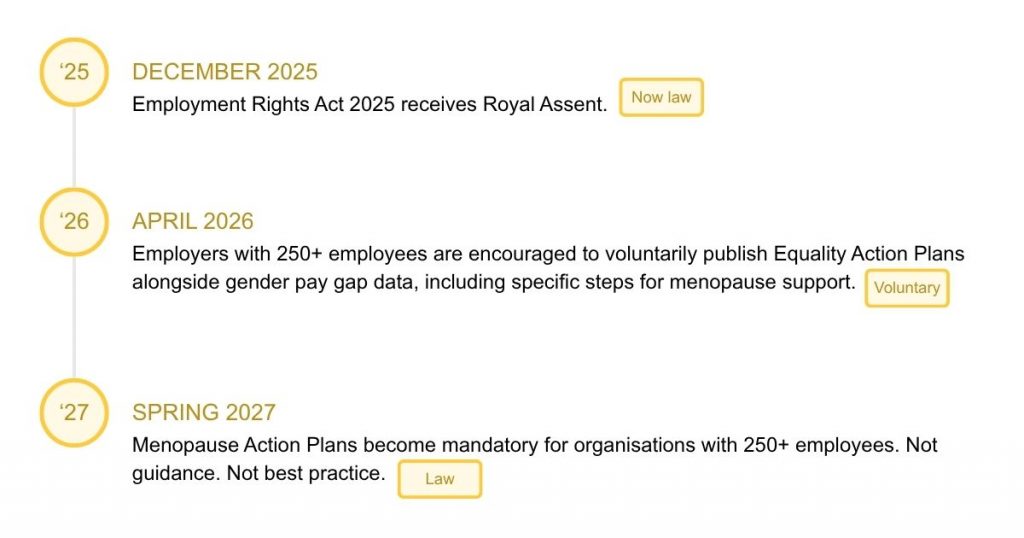
That’s not far away. And the difference between organisations that move now and those that don’t won’t just be compliance, it’ll be confidence. There’s a significant gap between producing a document under pressure and genuinely knowing your organisation is doing right by its people.
A menopause policy sitting in your HR portal is not a menopause action plan. I say this kindly, but I say it clearly.
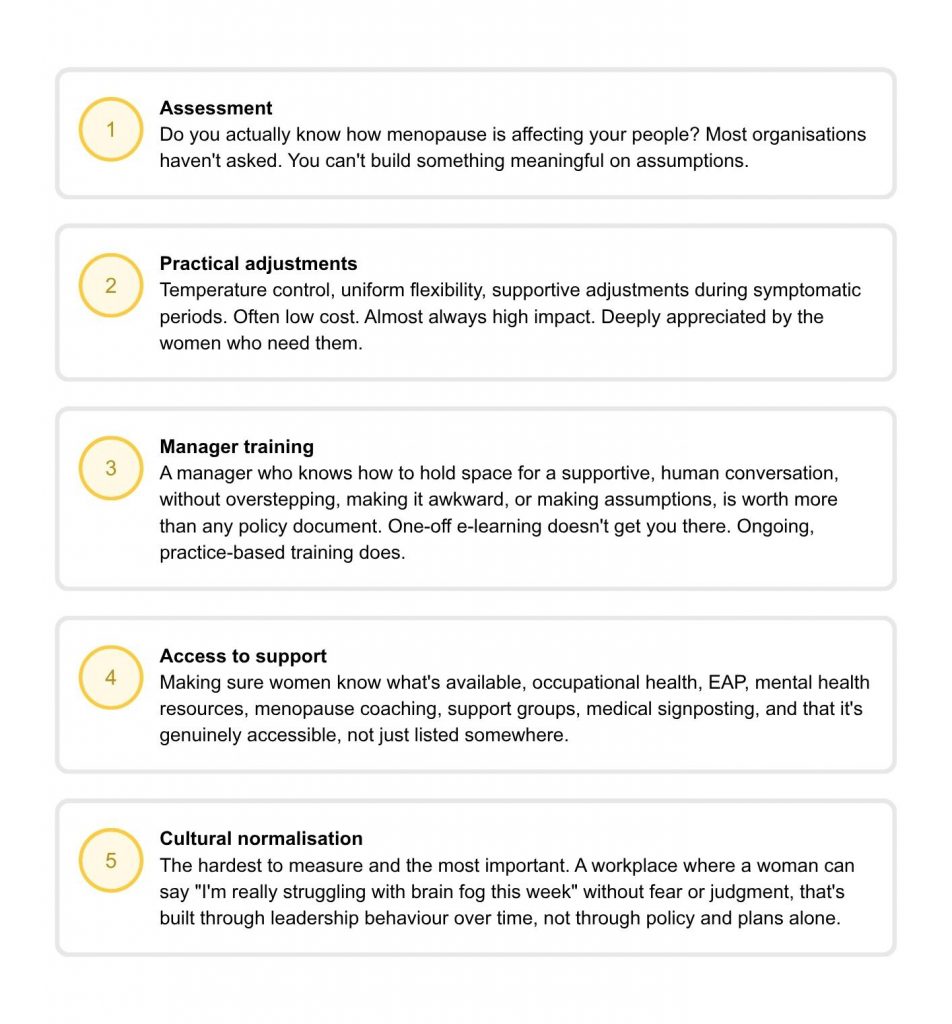
Government guidance is explicit that action plans must show what you are actively doing, not just what your intentions are. That means how you’re assessing the real impact of menopause on your workforce, what practical adjustments you’re making, how you’re equipping your managers, and what support women can actually access.
of women with menopause symptoms say those symptoms negatively affect their work
women have left employment entirely because the right support wasn’t there
These aren’t abstract statistics. They represent real women, real talent, real experience walking out of your organisation, and the majority of organisations have no idea it’s happening, because no one is joining the dots.
Add to this a growing legal risk. Menopause is increasingly being raised in employment tribunals under disability discrimination and sex discrimination law. Meaningful, documented action doesn’t just do the right thing, it significantly reduces your exposure.
A policy tells people you've thought about this. An action plan shows what you've actually done about it.
Government guidance points to five areas. Think of each one not as a compliance checkbox, but as a genuine question about your culture, because that’s what will make the difference between a plan that sits in a folder and one that actually changes things.
Compliance is not why I do this work. And it’s not the best reason for your organisation to act either, though it’s a very good prompt.
The organisations I’ve seen do this best are not the ones who were pushed into it by legislation. They’re the ones where a senior leader decided this mattered. That keeping brilliant, experienced, capable women in the workforce, and properly supporting them through something that affects roughly half the population for a significant chunk of their working lives, was simply the right thing to do.
A STORY THAT STAYED WITH ME
I spoke recently to a woman with a demanding job, smart, experienced, exactly the kind of person her organisation can’t afford to lose. She was struggling with brain fog and severe fatigue. She did the brave thing and went to HR.
The response she got? “Are you sure you’re still up to the job?”
She hasn’t spoken about it since. Instead she’s working harder than ever, terrified she’s been flagged, trying to prove she’s still capable. Fear is driving her career now. And the cruel irony is that the organisation that failed her is about to lose her anyway, just more slowly, and at greater cost to her health.
This is what the absence of leadership looks like up close.
Legislation gets you to minimum compliance. Leadership gets you somewhere genuinely different.
But here’s the practical reality too. If you’ve been trying to make the case for menopause support internally and feeling like you’re pushing uphill, the Employment Rights Act 2025 changes that conversation. You now have a legal requirement, a government-published framework, and a timeline. Your time is now.
If you’re reading this and realising your organisation is further behind than you’d like, here’s what I’d say.
Don’t try to do everything at once. The organisations that build real, lasting menopause support start with solid foundations: genuine understanding at leadership level, an honest audit of what’s already in place, and managers who can have a basic human conversation without panicking, and build from there.
Treat this as a cultural project with a compliance output. The action plan is the documentation. The culture is the point.
Get proper support. The organisations I work with through the Menopause Partner Programme move through this with confidence rather than overwhelm, because there’s a clear, structured pathway from where they are now to where they need to be. You don’t have to reinvent the wheel or piece this together from Google searches and government PDFs. The expertise exists. Use it.
If a senior leader in your organisation asked you today, “What are we doing about menopause, and is it enough?”, could you answer with genuine confidence?
If the honest answer is no, or not yet, or I think we’re okay but I’m not totally sure, then this is your moment to change that. Not just because the law is coming, though it is. But because the women in your workforce, experienced, capable, at the peak of their careers, are more than a compliance issue. They are the backbone of your organisation.
The deadline is coming. The organisations that move now won't just be compliant. They'll be leading.

Founder of Courage Coaching · Workplace Menopause Specialist · Executive Coach
courage-coaching.co.uk
